

How has the Sand Mafia eroded the state Authority in the Chambal region of Madhya Pradesh?
On 8 April 2026, a forest guard, Harkesh Gurjar, was killed in Morena after being run over by a tractor linked to illegal sand mining, allegedly connected to a local political figure. Disturbingly, this is not an isolated incident. In just the past three months of 2026, multiple such cases have been reported across the Chambal region, following a similar pattern where forest and police personnel are deliberately targeted using vehicles.
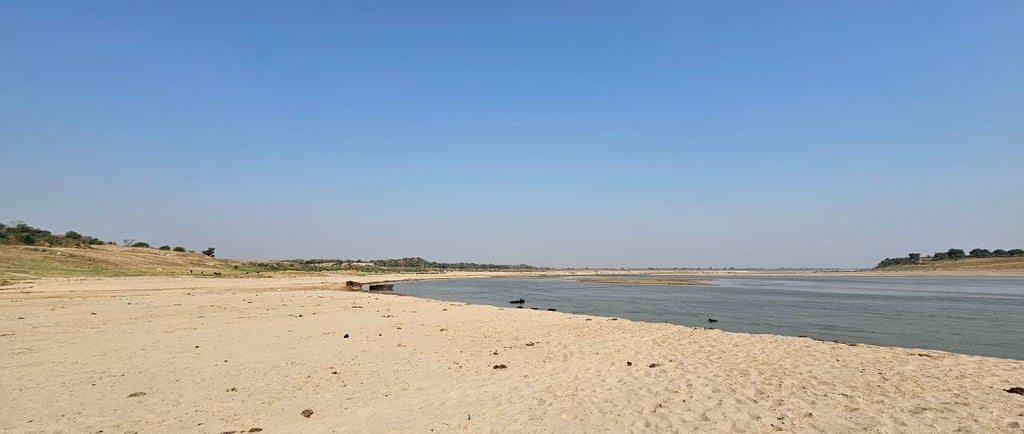
In the early days of April, a video was shared broadly online on many platforms; a district collector posted in the Morena district of Madhya Pradesh was seen sympathizing with the father of a forest guard, “Harkesh Gurjar," who had been killed by sand mafia.
On 8th April 2026, in Ranpur village under the Dimni constituency of Madhya Pradesh, Harkesh Gurjar, a forest guard, was run over by a tractor allegedly belonging to sand miners. He was part of a patrol team of four when they intercepted the vehicle, and as forest guard Harkesh moved forward to stop him, the driver allegedly ran him over and escaped with the vehicle
The Dimni constituency in the Morena District is represented by Narendra Singh Tomar, former Union Agriculture Minister and now speaker of the Madhya Pradesh Legislative Assembly. In this case, reports indicate that the tractor involved was owned by Pawan Tomar, the BJP's Dimni Mandal vice president, and Sonu Chauhan, a Mandal minister in the BJP Yuva Morcha. This is not the first time the Chambal region has witnessed such a killing. It is not rare anymore either.
In 2012, IPS officer Narendra Kumar Singh was killed in Morena when a tractor loaded with illegally mined stone ran him over. The CBI, in its investigation, treated the incident as an accident, an interpretation that has since come to symbolize how the system often processes violence when it emanates from entrenched economic networks.
In just the first four months of 2026, there have been at least three more attacks linked to sand mafias across the Chambal region. In January, forest guard Jitendra Singh Shekhawat was killed in Rajasthan’s Dholpur district using the same modus operandi while attempting to stop a mining vehicle. In February, an attempt was made to run over a constable in Morena. That same month, in Gulab Singapura Village of Sabalgadh, a forest team that had seized a tractor trolley came under fire. In March, a police vehicle heading to act against illegal mining was rammed by a tractor-trailer, leaving Constable Sudama Razak seriously injured.
Over the past decade, more than six police personnel have died in similar incidents in the region. Forest guards in this region, as has now been admitted, have been confronting organized mining networks armed with modern vehicles and, in many cases, firearms, with nothing but sticks. For over five years, they have not been provided with any firearms; they have been handed sticks. In March last year, a video had gone viral in which miners openly threatened forest officials, warning that they would be shot if they attempted to intervene. No meaningful action is followed.
The consequences are not limited to officials on patrol. On March 26, 2018, investigative journalist Sandeep Sharma was killed in the Bhind district when a dump truck rammed his motorcycle. Sharma had reported extensively on illegal sand mining and had exposed alleged links between the mafia and local police. He was killed in the same way as enforcement officers continue to be killed.
The Supreme Court took Suo motu cognizance of illegal sand mining in the Chambal region last week. A bench of Justices Vikram Nath and Sanjeev Mehta delivered an unusually sharp indictment of the situation. The Court recorded that the State of Madhya Pradesh itself had disclosed that forest officials do not possess the necessary equipment, “more specifically, adequate weaponry,” to deal with sand mafias who are “armed with superior weaponry and modern vehicles.” This, the Court said, exposes “a shocking state of unpreparedness and a lack of institutional will,” adding that “the state cannot be permitted to plead helplessness.”
The language did not stop at administrative criticism. The Court went further, observing that illegal mining continuing “right under the very noses” of authorities “reeked of apathy, tacit connivance, and even a sense of helplessness” in the face of the miners’ “superior firepower” and lawlessness. It underscored that this situation strikes at the very foundation of the rule of law.
In a significant directive, the bench ordered that Madhya Pradesh, Rajasthan, and Uttar Pradesh must, in close coordination, formulate and implement a comprehensive, uniform, and time-bound standard operating procedure to deal with illegal sand mining, particularly where it involves organized, violent, or armed resistance.
Legally, sand is classified as a “minor mineral” under the Mines and Minerals (Development and Regulation) Act, 1957. Its regulation lies primarily with state governments under rules framed through Section 15 of the Act. In theory, this decentralization should enable localized control. In practice, it has produced fragmented enforcement, weak oversight, and regulatory arbitrage, especially in a tri-state region like Chambal, where jurisdictional boundaries are porous, but mining networks are not.
However, Sand is indispensable to India’s construction sector. In developing India, demand is relentless, legal supply is constrained, and profits from illegal extraction are growing. In such a system, enforcement becomes somewhat difficult, while illegality becomes structural.
This is why the Supreme Court’s intervention, while necessary, cannot by itself resolve the crisis. A Standard Operating Procedure can coordinate action, but it cannot substitute for political will. Nor can it address the deeper incentive structure that makes illegal mining both lucrative and, in many cases, protected.
The image of the collector hugging the victim’s father endures because it captures the contradiction at the heart of the state today, and in that hesitation lies the reason why a tractor driver no longer fears the law and why, increasingly, the line between governance and abdication is being erased in the dust of mined riverbeds.
PALIPRAYAS FOUNDATION
People Advocating for Low-Carbon Impact