

How is the government deliberately IGNORING over 41 percent of Delhi’s pollution?
Delhi’s air crisis is repeatedly blamed on geography, but data tells a different story. Drawing on recent findings by the Centre for Research on Energy and Clean Air (CREA), this piece exposes how coal-fired thermal power plants, weak regulation, and lack of emission monitoring are driving nearly half of Delhi’s winter PM2.5 pollution. It critically examines government inaction, misplaced priorities, and the dangerous illusion of pollution control through cosmetic measures.
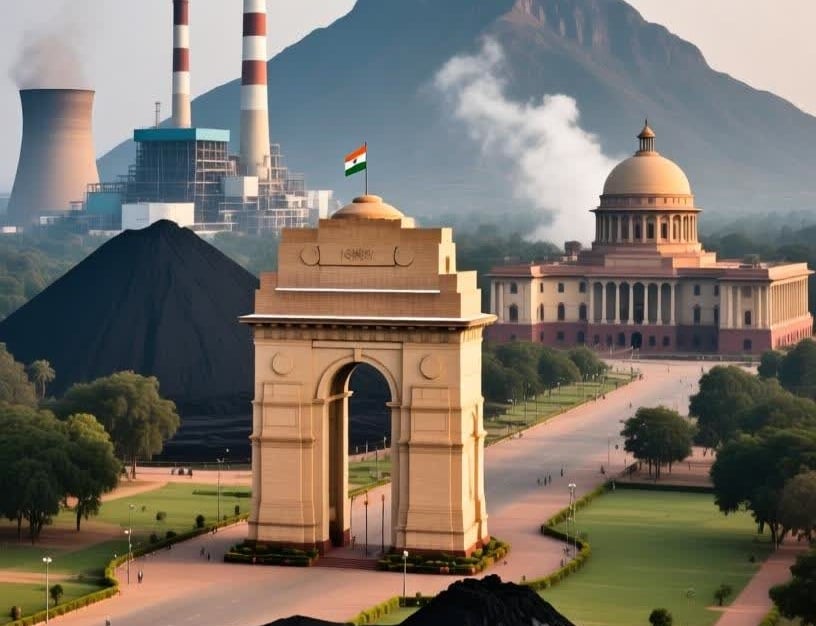
We’ve often seen the sympathizers of the current government in Delhi and the centre arguing about the geographical location of Delhi as main drawback while minimizing pollution but data shows otherwise. One such research published recently does the same.
According to the Centre for Research on Energy and Clean Air (CREA)[1], nearly one-third of Delhi’s PM2.5 pollution comes from ammonium sulphate. PM2.5[2] refers to extremely fine particles with a diameter of 2.5 micrometres or less. These particles are so small that they enter deep into the lungs and even the bloodstream, causing asthma, heart disease, strokes, lung cancer, and premature deaths. PM2.5 is widely considered the most dangerous air pollutant.
While, Ammonium sulphate is not a direct pollutant. It is a secondary pollutant, meaning it forms in the air through chemical reactions. The process begins with the release of Sulphur dioxide (SO₂), which mainly comes from coal-fired thermal power plants. Once released, SO₂ reacts with ammonia and other compounds in the air to form ammonium Sulphate particles. These particles then become a major component of PM2.5, significantly worsening Delhi’s air quality and turning industrial emissions into a serious public health hazard.
CREA’s study also shows that the situation in the current season is more serious whereas the government is mostly focused on dust control measures in Delhi that too with no evidence on effectiveness of the vehicles they use to control the dust. During the winter season, ammonium sulphate contributes around 41% of Delhi’s PM2.5 pollution. This means that at the time when Delhi already suffers from severe smog, emissions from coal-based power plants play an even bigger role in choking the city.
Despite this clear scientific evidence, the government has failed to act. Within a 300-kilometre radius of Delhi, several coal-based thermal power plants are still operating without Flue Gas Desulfurization (FGD) systems.[3] FGD systems are essential pollution-control technologies that reduce sulphur dioxide emissions by up to 90%[4].They are critical to preventing the formation of secondary pollutants like ammonium sulphate.
An analysis of Central Electricity Authority (CEA) data for the period November 1–19 highlights how the government has failed to enforce basic pollution-control norms. As reported by The Indian Express on November 13[5], at least 15 generating units across six coal-based thermal power plants located within a 300-km radius of Delhi were found to be operating without Flue Gas Desulfurization (FGD) systems during this period. These include four units in Haryana and 11 units in Punjab.
What makes this negligence even more alarming is the lack of basic monitoring. As reported by NDTV on 13 December[6], the Central Pollution Control Board (CPCB) has not conducted any comprehensive stack emission monitoring of 11 thermal power plants located within 300 km of Delhi for over a decade. For ten years, there has been no serious assessment of how much pollution these plants are releasing into the air that millions of people breathe.
This raises a disturbing question: how can the government claim it is tackling air pollution when it does not even measure emissions properly? Without monitoring, there is no accountability. Without accountability, pollution control becomes just a paper exercise.
At this point, it is impossible to accept the claims. Their repeated statements that “work is being done” to control air pollution are not just misleading they are a blatant lie. When scientific evidence clearly shows that around 41 percent of Delhi’s PM2.5 pollution in winter comes from sources like ammonium sulphate linked to coal-fired thermal power plants, allowing these plants to continue operating unchecked is not governance—it is deliberate neglect.
The government’s obsession with water-sprinkling machines and anti-smog guns with no proven effectiveness is nothing but pollution control propaganda. These machines create an illusion of action, while the real sources of pollution continue to poison the air. Claiming success through such superficial interventions, while ignoring coal-based emissions that form nearly half of winter pollution, is not just incompetence—it is deception.
Clean air is a basic right, not a privilege. Delhi’s toxic air is not inevitable, it is the result of policy inaction, regulatory failure, and a lack of political will. Until the people treats air pollution as a real emergency and hold the government accountable, Delhi will continue to suffer.
REFERENCES
[1] https://energyandcleanair.org/publication/secondary-particulate-matter-is-a-core-driver-of-dangerous-pm2-5-in-india/
[2] https://www.epa.gov/pm-pollution/particulate-matter-pm-basics
[3] https://www.thehindu.com/sci-tech/energy-and-environment/what-are-flue-gas-desulphurisation-units-explained/article69698678.ece
[4] https://www.intensiv-filter-himenviro.com/case-study/flue-gas-desulphurisation-fgd-process-types-benefits-and-future-trends/
[5] https://indianexpress.com/article/explained/explained-economics/delhi-16-power-units-capital-so2-controls-10380221/
[6] https://www.ndtv.com/india-news/no-monitoring-of-emissions-from-11-coal-plants-near-delhi-for-10-years-rti-9803377
PALIPRAYAS FOUNDATION
People Advocating for Low-Carbon Impact