When Justice Becomes Smoke: The Green Cracker Illusion
AIR POLLUTION
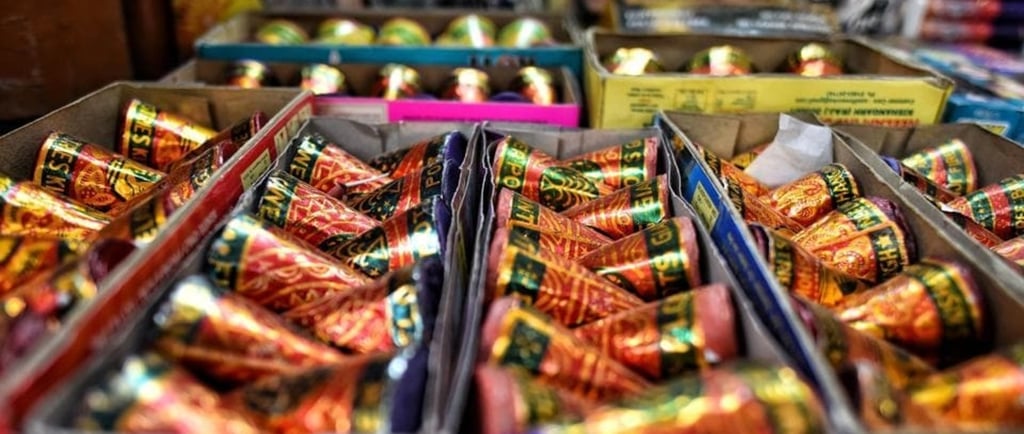
The story of “green crackers” in India began as a promise—a promise that law, science, and tradition could coexist. It was meant to show that festivals could stay joyful while the air stayed breathable. Yet, years later, this experiment stands as a symbol of how good intentions without institutional grounding can end up betraying the very people they were meant to protect.
The idea of green crackers was born out of desperation. In 2015, three infants, not even a year old, approached the Supreme Court through their parents. They were not asking for comfort or compensation—they were asking for the right to breathe. Their petition, filed under Article 21 of the Constitution, argued that air pollution had become so severe that it violated the fundamental right to life. This was no exaggeration. The winters of 2016 and 2017 had seen Delhi and its neighboring regions suffocated by smog. The Air Quality Index regularly crossed 500 — a level described as “severe” or “hazardous.”
Faced with this public health emergency, the Supreme Court sought to act. Yet it found itself torn between two realities—on one hand, the undeniable health impact of fireworks; on the other, the livelihoods of millions of workers in the fireworks industry and the cultural sentiment attached to celebrations like Diwali. On 23 October 2018, the Court chose a middle path. It banned traditional firecrackers that used harmful heavy metals such as barium and directed the Council of Scientific and Industrial Research (CSIR) to develop “less-polluting alternatives.” These new inventions were soon to be known as “green crackers.”
Scientists at CSIR and its National Environmental Engineering Research Institute (NEERI) worked quickly to develop safer formulations. They created three main variants: SWAS (Safe Water Releaser), STAR (Safe Thermite Cracker), and SAFAL (Safe Minimal Aluminum). These were designed to emit 30 percent less pollution and replace hazardous substances with safer compounds. The idea was that these crackers would release water vapor, use less aluminum, and remove ingredients like potassium nitrate and sulfur. In simple terms, they would burn cleaner.
In 2019, these new products entered the market. The Petroleum and Explosives Safety Organization (PESO) was tasked with certifying them, and QR codes were introduced so that buyers could check whether they were truly “green.” On paper, the system looked precise and promising. In practice, it collapsed almost instantly. There were no effective laboratories to test compliance, no public awareness campaigns to educate citizens, and no monitoring at the local level. Fake green crackers began flooding the market. For most people, there was no way to distinguish between genuine and counterfeit ones.
The confusion deepened as different authorities issued conflicting orders. In 2020, the National Green Tribunal declared that even green crackers could not be used in areas where air quality was “poor or severe,” which included almost every major city. In 2023, the Supreme Court clarified that it had not imposed a universal ban, leaving state governments free to establish their own rules. And in 2025, the Court again relaxed the ban in Delhi-NCR, allowing limited sales and use during Diwali. Each year brought a new order, a new clarification, and the same polluted air.
The failure of this entire experiment is not scientific; it is political and institutional. It reflects a chronic flaw in India’s environmental governance — the absence of mechanisms that connect judicial pronouncements with administrative follow-through. Courts act as moral guardians, stepping in where the state fails, but without creating enforcement systems, their words remain symbolic. The Supreme Court’s ruling on firecrackers was never backed by a permanent monitoring body. There was no accountability framework for manufacturers or local governments. The implementation depended on vague instructions and voluntary compliance—a recipe for failure.
This is what political scientists call a “policy illusion.” It happens when institutions announce reforms that sound progressive but lack the structure to make them real. The illusion comforts the conscience of the ruling class and satisfies the moral expectations of the public, but nothing actually changes. Green crackers became the face of this illusion — a “green” label masking the same toxic reality.
Even scientifically, the notion of green crackers was more of a compromise than a solution. A 30 percent reduction in emissions might look good in a laboratory but means little when multiplied across millions of firecrackers in a city already drowning in smog. The manufacturing process remains hazardous, the workers are still exposed to chemicals, and the environmental gains are negligible. QR codes, the supposed mark of authenticity, are rarely verified by consumers. PESO’s testing mechanism is limited and stretched thin. In most cities, enforcement begins and ends with token police checks.
The tragedy is that a ruling meant to protect the right to clean air has ended up diluting it. Instead of holding institutions accountable for air management, the burden has been shifted to individuals. People are told to celebrate “responsibly,” as if public health were a matter of personal virtue rather than systemic failure. The state escapes responsibility by hiding behind slogans like “green crackers,” turning environmental justice into a moral choice rather than a legal duty.
This betrayal is not just environmental — it is constitutional. The same court that recognized the right to clean air did not ensure the means to secure it. The people who came seeking justice have been left with symbolic relief. The children who filed that 2015 petition are now in school, breathing the same smoky air that once endangered their lives as infants.
The larger question, therefore, is not whether green crackers pollute less, but whether our institutions are capable of delivering real environmental governance. Courts cannot replace governments, and science cannot fix what politics refuses to enforce. Without a system of accountability—real testing, transparent data, and empowered local bodies—even the most progressive rulings will remain words on paper.
In the end, the story of green crackers is the story of how justice, when detached from ground realities, loses its substance. A judgment meant to bring clean air instead brought confusion. A reform meant to unite science and tradition ended up pleasing neither. The smoke that rises every Diwali is not just from fireworks; it is from the burning of faith in our institutions.
When rulings are made without systems to sustain them, they do not illuminate—they only flicker and fade. The Supreme Court lit a match, but there was no hand to hold the flame steady. And so, what began as an act of justice dissolved into smoke—leaving the people once again gasping for air and for accountability.
ALSO READ
PALIPRAYAS FOUNDATION
People Advocating for Low-Carbon Impact